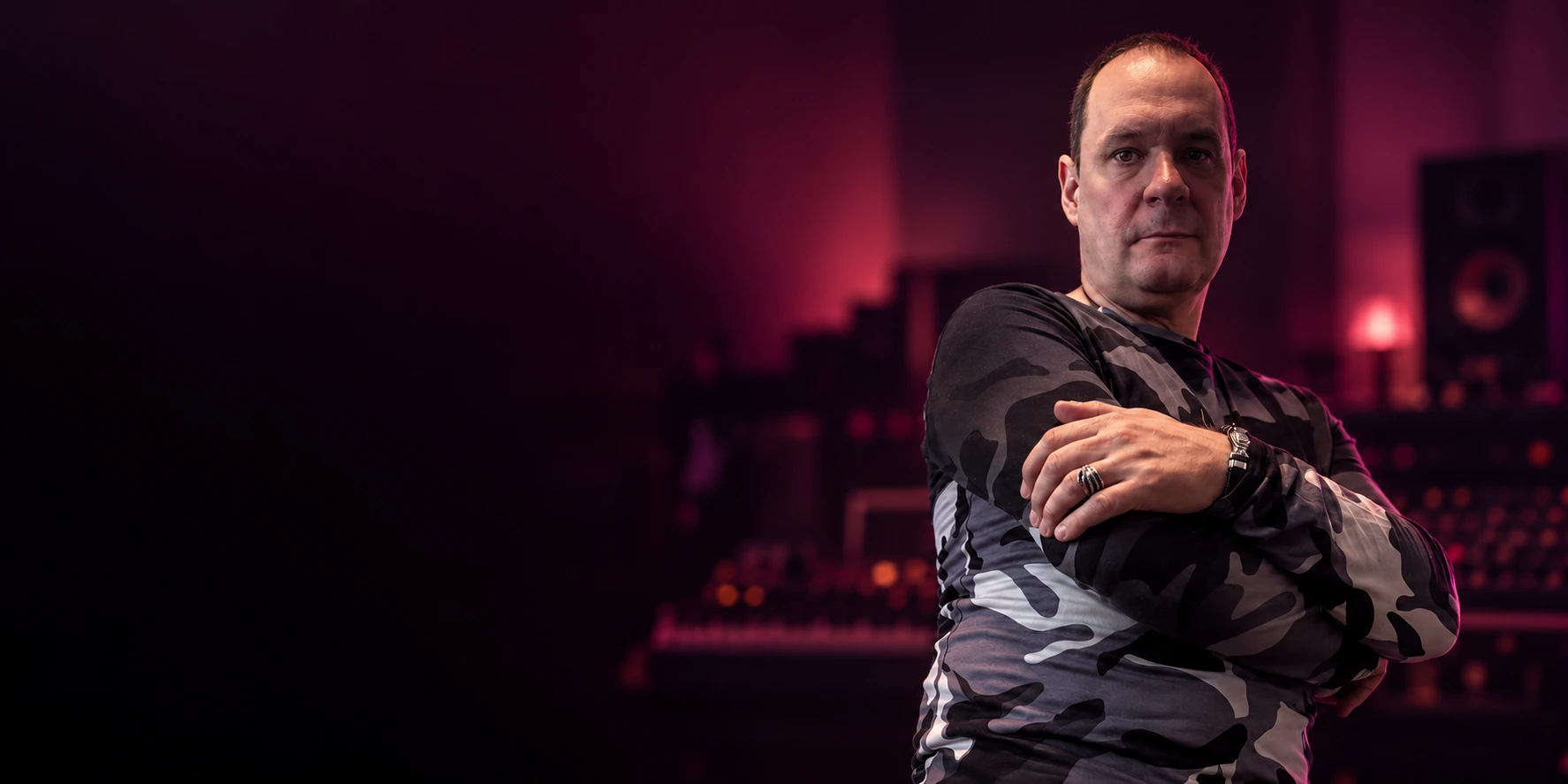
VALERIANSTEEL.
Let the machine push back.
Valerian Steel on Manufracture Music, analogue imperfections and A.C.I. — Analog Core Industrial as a working method and artistic position.
MANUFRACTURE MUSIC · A.C.I.A sound does not fit the current project. Valerian Steel saves it anyway. The machine has produced something he could not have planned — and that is where the next possibility begins. In Manufracture Music, friction is not residue to remove at the end. It belongs to composition.
Valerian works in Vienna across industrial, EBM and darkwave. Alongside Manufracture Music, he pursues Music of Synergia and Fortyfication*5; his collaborations with Enzo include Ghosts and other releases. System Apathy is scheduled for 20 October 2026. This conversation explores musical depth, decisions made at the machines and an approach he calls A.C.I.
More than a bassline.
Piano and choir do not appear in this story as nostalgic alternatives to electronics. Valerian describes them as the foundation of his understanding of structure. A rough synthesizer sound has to carry weight: harmony, friction and development belong together.
You played piano and sang in a choir before your electronic projects. What remains from that early period in Manufracture Music, even when it isn’t immediately audible among synthesizers and drum machines?
Quite a lot, actually, especially my basic understanding of music and my sense of song structure. It simply bores me to death when EBM and post-punk tracks consist of nothing but an endlessly unchanging analogue bassline, a kick and a snare. That’s just not enough for me. I was recently at a concert by a fairly well-known act, and the support act was basically just a guy with a keyboard. He played his set with absolutely no imagination — always the same dull bassline, a few minimal rhythmic variations; only the lyrics changed now and then. The whole audience was visibly bored. I really wonder: who puts themselves through that, and which agencies book something like it? But apparently there are people in the mainstream of this scene who are into precisely that monotony.
My approach is different. Because of my musical background, I need more depth. I absolutely adore the dirty, rough sound of synthesizers, but for me it only gets really exciting through the interplay of harmonies and deliberate dissonances. The machines shouldn’t just doggedly hammer out a beat; they should carry real musical weight. And another thing: my tracks aren’t designed to reach their climax after three seconds just to cater to modern streaming attention spans. I consciously make music away from that fast-food mainstream — for people who are still willing to engage intensely with music and really listen.
The machines shouldn’t just doggedly hammer out a beat; they should carry real musical weight.
Keep the mistake.
System Apathy carries that approach into a current piece. On its official release page, Valerian lists his synthesizers and rhythm machines. In the interview, he describes what no equipment list can show: the moment an accident becomes material.
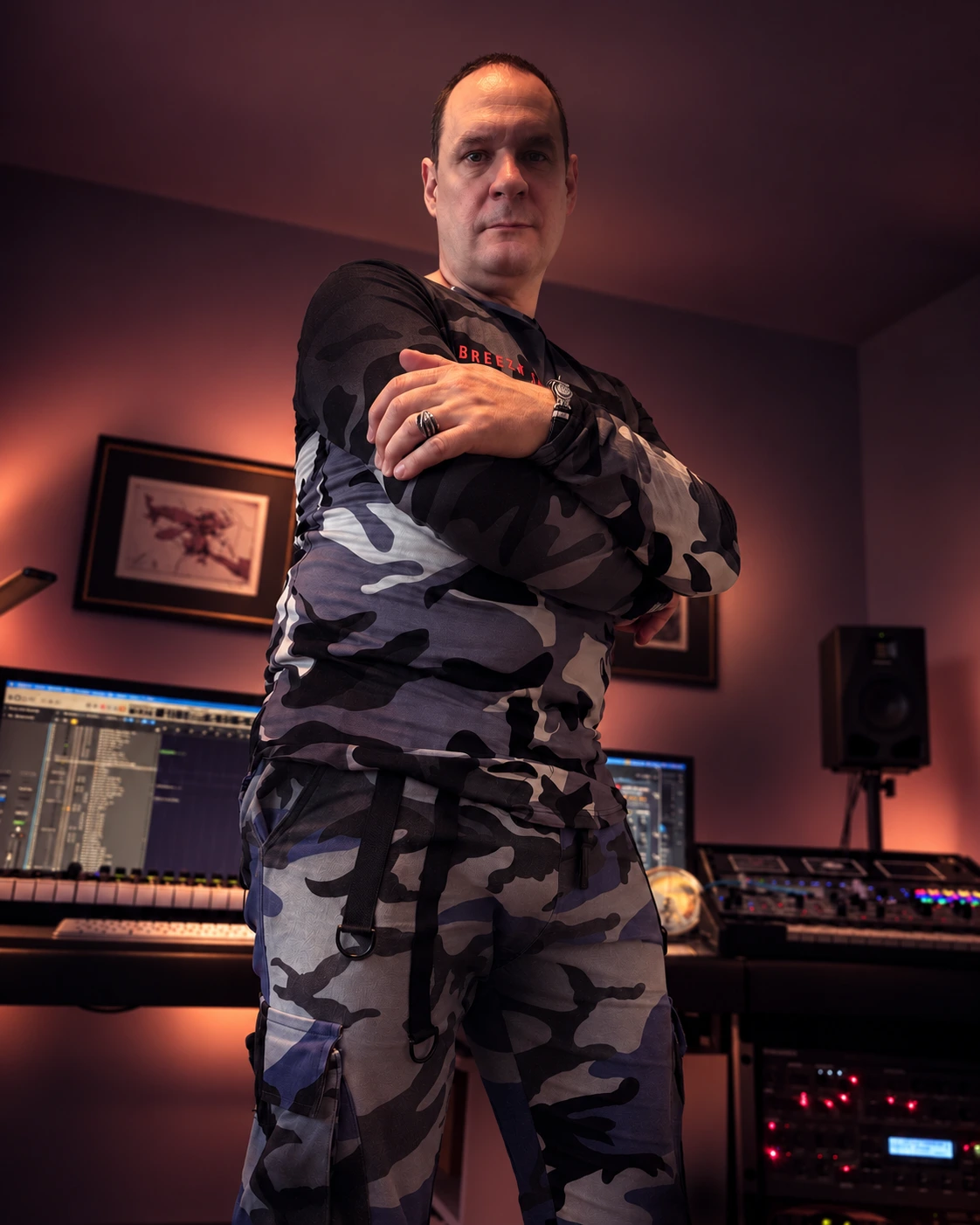
System Apathy is due on 20 October. You describe your devices’ quirks and limitations becoming part of the composition. Can you recall a moment when a machine did something you hadn’t planned — and you kept it?
Working on new tracks is always about trying things out and experimenting for me. You really have to be careful not to lose yourself completely in the studio. You’re bent over the synths, tweaking the filters, and suddenly, by some accident, the machine spits out an incredible rough sound you could never have planned. I save things like that immediately, even if they don’t fit the current project at all. Those exact moments — when the devices start developing a life of their own and appear to make ‘mistakes’ — are things I deliberately leave in pieces like System Apathy as stylistic elements, rather than smoothing everything out.
For me, a dirty synth sound often has even more depth than a classical piano sound. You can completely sink into a massive analogue texture and launch yourself into other worlds. Sure, on a piano you can decide whether to play pianissimo, fortissimo or staccato, or introduce alterations into the melodies. But with a synth, the MIDI standard alone gives you 128 parameters to bend and shape the sound completely. With an acoustic instrument, you’re quite limited by comparison. I need that enormous sonic potential to create exactly the atmosphere I have in my head. I’d be bored downloading ready-made MIDI files just to use them to mindlessly control software plug-ins on a computer. In my studio, I still get hands-on, compose and push the hardware’s potential.
A.C.I. — sound becomes a position.
Analog Core Industrial is Valerian’s own term. It connects hands-on work at physical instruments, a deliberate embrace of their quirks, and a tension between analogue music and AI-generated images. He released The Scene Lies manifesto on 14 August 2026. At the end of this conversation, he explains how he understands that tension personally and politically.
Compose at the instrument.
Leave the imperfections in.
Make the contradiction visible.
The sound knows the route.
For Valerian, three projects mean three different sonic worlds. Their identity is not decided only when a name goes on the cover. Often the first sound tells him where an idea belongs — even if there is not immediately time to realise it.
Alongside Manufracture Music, you make Music of Synergia and Fourtyfication*5. When a new idea appears in the studio, how do you know which project it belongs to? Do ideas ever end up in a different project along the way?
It’s actually quite easy to answer. Most of the time it’s decided very early, while I’m tinkering with a new sound. As soon as a sound takes shape, the right ideas come to me and I instinctively feel which project it was made for.
The three projects are completely different stylistically, and each direction needs its own kind of sound. Music of Synergia leans towards cinematic darkwave with strong ambient influences, and usually works with a female voice. Fortyfication*5, on the other hand, builds much more on direct, danceable cyberpunk elements. Because their sonic DNA is so different, it’s extremely rare for an idea to suddenly end up in another project along the way. The sound itself already sets the route. At the moment, a simple lack of time means I unfortunately get far too few chances to work on Fortyfication*5. But a whole lot of ideas are gathering in the background for that project, and I’ll definitely put them into practice someday, once there’s time.
A voice changes everything.
A finished arrangement is not necessarily the final word. After recording Ghosts, Enzo’s voice led the piece in a new direction. Released on 25 May 2025, the track also represents a willingness to reopen work that seemed complete.
You’ve worked with Enzo on several releases. Do you give him finished music, or can his voice still change the arrangement? Can you tell us about a collaboration that took an unexpected turn?
Enzo’s voice is simply extraordinary to me. When we work together, he already knows quite clearly what he’s getting into, and records the vocals at my studio. Fundamentally, I already have very specific ideas about the track beforehand. But a voice, and the mood it carries, can ultimately lead to quite a few adjustments. That usually makes the whole thing more expressive in the end; spontaneous variations come in, and of course Enzo brings his own ideas too.
A good example of an unexpected turn was working on Ghosts. I actually had the instrumental arrangement completely finished. But afterwards, as I listened to Enzo’s recorded vocals on their own a few times, I suddenly had a much better idea for an accompaniment that suited them even more closely and created more atmosphere. So I promptly rewrote almost everything from scratch. That’s how it goes: it’s a dynamic creative process in which you sometimes have to overturn things you’ve already finished if you’re not one hundred per cent satisfied.
A universe of his own.
For now, independence in the studio is a condition of Valerian’s work. He does not describe it as a permanent refusal to collaborate. There are ideas for working together — but he is not naming names yet.

You make your music in Vienna. Where do you exchange ideas with other musicians, and who would you like to experiment with in the studio?
When it comes to exchange: in real life, I’m actually an absolute team player. But with my music, I currently have very uncompromising ideas of my own that I want to realise and make audible exactly as I imagine them. That’s why, for now, I’m still largely moving within my own universe when I produce. But that certainly doesn’t mean something couldn’t happen in that direction someday — every undertaking has its time. And yes, there are definitely some great artists, whether well-known or still completely unknown, whom I’d love to stand beside at the machines in the studio. A few concrete ideas are already floating around in my head... but for now I’ll keep who they are to myself. Perhaps there’ll be more on that elsewhere when the time is right...
An uncomfortable manifesto.
Valerian asked for room for a final thought. Here he discusses the tension he wants A.C.I. to expose: handmade music and generated images used as provocation. The following statements are his personal position; SCENE:ID has not independently confirmed the AI-detection figures he cites.
Since you’ve given me room for my own thoughts, here’s another point that’s extremely important to me and defines my Analog Core Industrial approach. We have to face the truth: AI has long been steering all of us. It has become a real danger to humanity, and we finally need to start handling this technology responsibly! Pandora’s box is wide open, and things are slipping completely out of our hands — even to the point of people basing their voting decisions on algorithmically spread AI lies. That’s exactly why I produce my music entirely in analogue form, but quite deliberately combine it with these ‘AI-slop videos’. It’s my artistic middle finger to this unthinking AI obsession.
Take the EBM scene, for example. Honestly, it isn’t important to me whether these backward-looking EBM and goth purists listen to my music at all. What they urgently need to drop, though, is their incredible double standard. These people seriously tell me that absolutely anything even remotely connected with AI is fundamentally evil, bad and reprehensible. And here comes the pure real-life satire: they type these moral lectures at me on platforms like Reddit — networks that are demonstrably and massively driven by algorithms and AI down to the last snippet of code! They no longer grasp how blindly they themselves are already in the grip of the machines they want to warn me about. How cynical is that?
And it gets even more absurd: there, this mob cheers on new releases by big, well-known bands in the scene. I ran their stuff through an AI detector as a test — some results came back as more than ninety per cent AI-generated. Their music as well as their videos! These people blindly celebrate pure fakery, then pounce on someone who openly and honestly says: ‘Yes, I deliberately use AI videos as an artistic device and protest.’ Anyone who doesn’t understand that meta level is beyond help.
I also stated this subject, and my direct attack on these hypocrites, unequivocally on my Bandcamp release — a point that, fortunately, Side-Line Magazine picked up and linked to accurately in its report about me.
Every artist worth taking seriously communicates a message through their work. I’m not trying to please everyone; I’m trying to expose this madness and use my art to put my finger directly on this dangerous hypocrisy.
System Apathy
Scheduled for 20 October 2026.