VANESSASA.
When everything becomes one.
Vanessa Sa on piano keys, rap attitude and the people who make a rave mean more than the next booking.
SOUNDLABS · DJ / PRODUCERA preset needs time. A key responds to touch. Eventually an arrangement takes shape, ready for a rap voice to give it just the right attitude. Vanessa Sa describes techno as something that first passes through her hands — then lives on between DJ, crew and crowd.
The Vienna DJ and producer moves between psytechno, hardgroove and bounce. Soundlabs is her collective and, in her words, her techno family. This conversation travels from the keyboard through That Bassline to a closing slot at Karlsplatz: five glimpses of a practice guided by feeling and supported by the work of a crew.
The hands remember.
The piano keys don’t disappear when the music becomes electronic. They remain Vanessa’s way into sound, dynamics and timing. A synthesizer expands that familiar movement; the vocals arrive later, bringing another language to the arrangement.
You learned classical piano as a child, and later hip-hop and rap shaped you. When you build a track today, where do those two worlds still meet? Is there one of your own tracks that helps explain it?
The pattern runs through practically all my tracks. I play everything apart from the kick, percussion and vocals on the keyboard. Every preset responds differently to the touch of a key, and takes a different amount of time to unfold and come into its own. In truth, I’m basically playing piano all the time — just with an infinite range of tonal possibilities. Once my instrumental arrangement is in place, I love sprinkling rap or MC vocals over it for the right attitude.
In truth, I’m basically playing piano all the time — just with an infinite range of tonal possibilities.
An idea that stays.
For Vanessa, a jam becomes a track through something a checklist cannot capture. The idea has to survive long after its first novelty wears off. With That Bassline, she can describe that feeling precisely: synthesizer, groove and voice coming together.
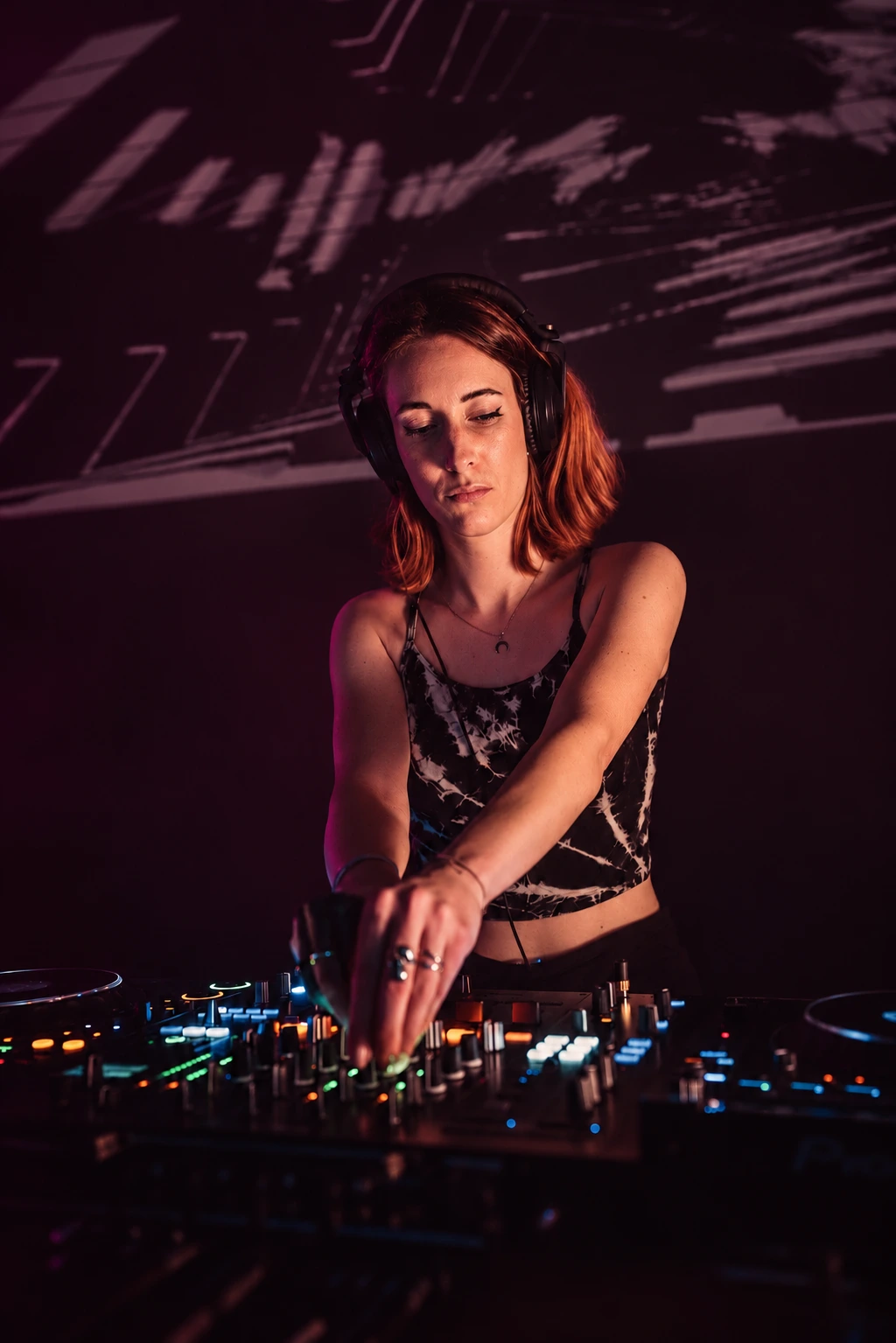
You’ve released your own music on Fempire, including Voyager and Dizzy. Pick one: what small idea came first, and when did it become something that made you think, yes, this is me?
Every new project starts from a gut feeling. For a jam to become a concrete sketch, it has to really resonate with me. It’s less about particular criteria — I quickly sense whether I genuinely feel a track. Then I know I’ll still like the idea after hearing it a hundred times. With That Bassline, for example, the combination of the rasping synthesizer, psychedelic groove and female vocals was exactly what gave it that special something for me.
Techno family, in practice.
Here, the crew means more than a name on a line-up. The bar, technical setup and stage all depend on shared work. Vanessa talks about trust, her responsibility as DJ Lead and the moment when everyone comes together again at closing.
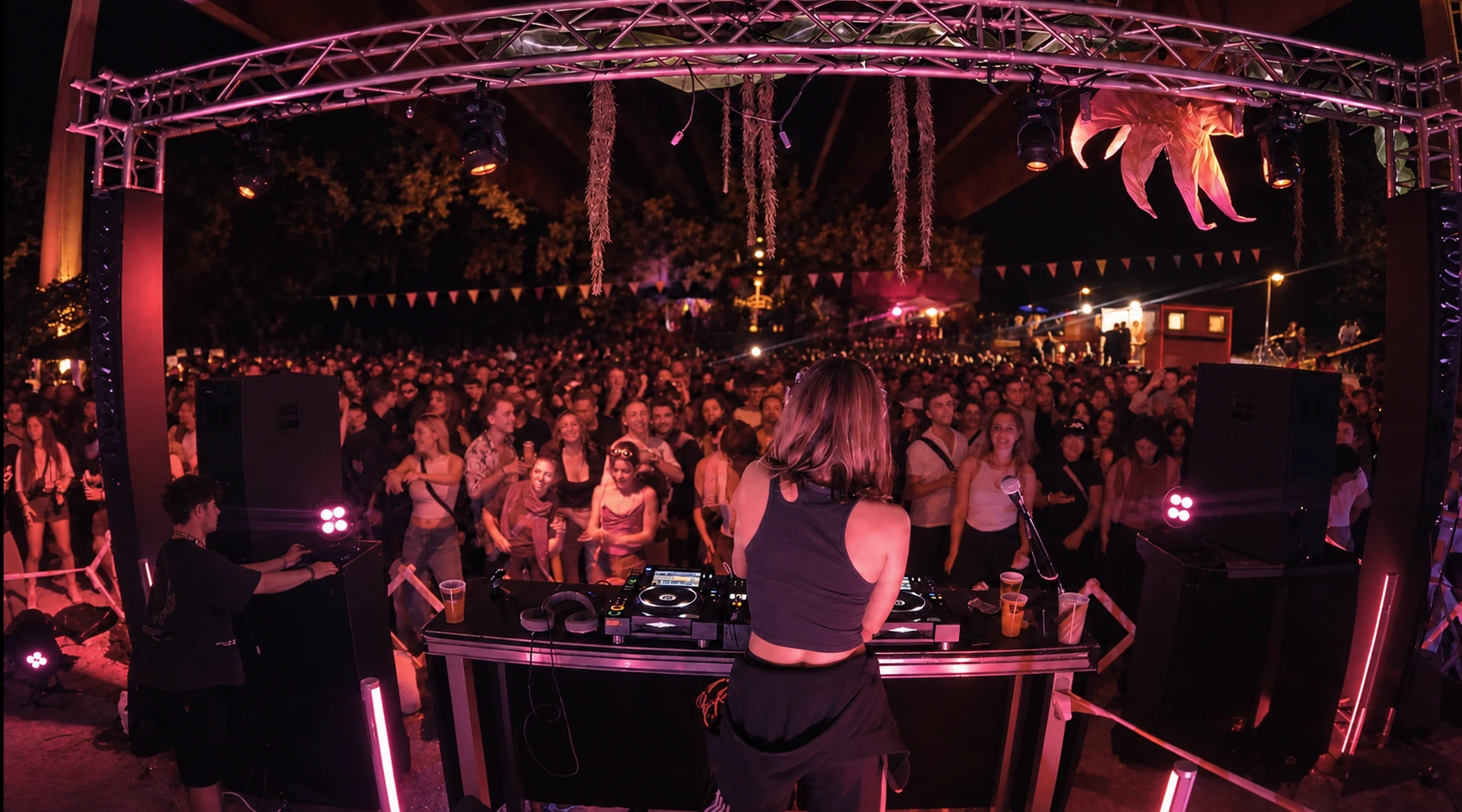
Rave meets Charity is part of the Soundlabs idea. What has this crew given you that you might not have found on your own as a DJ? Can you recall a moment when you realised it meant more than the next booking?
Belonging to Soundlabs was a springboard for me as a DJ. But far beyond that, the people there have become my techno family. Nobody can organise events on this scale alone. As a well-rehearsed crew, you can do more than put on an event: you can create a space of your own, bring artistic concepts to life, donate proceeds to NGOs and celebrate techno at the same time. People with the right values and skills have come together here. And I’m all the happier to have the team’s trust and to be DJ Lead in the collective.
The Resselrave right in the middle of Karlsplatz was our first event alongside smaller TU parties. Every time, it’s impressive to see the team work together and build the bar, technical setup and stage from the ground up like clockwork. During the closing slot, it has become a tradition for the entire crew to join the crowd in going wild in the booth. Every time, it’s a goosebumps moment full of love.
A dancefloor without a door.
In a club, the audience has made a deliberate choice. Outside, the first encounter can happen by chance. Vanessa is drawn to that open moment: someone stops and discovers something in the music that they never expected to find.

You played Melange à Trois on the Donauinsel as part of Free Spaces. What changes when people outside can simply join in, rather than deliberately choosing a club night? Do you remember an encounter or reaction that day?
When people go to a club and pay admission, they have certain expectations of the sound. What I find so exciting about open airs with passing audiences is that people who might not describe themselves as into techno encounter my sound. By now, I’ve heard from people several times that they hadn’t expected to enjoy this kind of techno so much. That is exactly what being a DJ is about: bringing music and emotions to people who perhaps never thought it could stir something in them.
Tension needs room.
Intensity alone cannot sustain an entire set. A groove can make space for the next peak to mean something again. For Vanessa, changing genre belongs to one continuous movement: building tension, releasing it and keeping contact with the crowd.
You don’t commit to a single genre. When you move from something hypnotic to something playful or harder, how do you know you can take people with you? Has a transition ever surprised you with its response?
As long as the flow isn’t interrupted, anything goes. I do prepare my sets stylistically to suit the event I’m booked for, though. Still, it’s refreshing to slip in a track from another genre sometimes. Especially between very hard tracks built around drops, the right groove track can act like a brief breather and make the build-up to the next drop even stronger. That lets you build and release tension across the entire set. And when it works and DJ, crowd and music connect — then everything is one.